A modern kitchen interior with dark wood and black cabinetry, with a 100cm Elice ceiling hood in black above a white countertop, a gold Foster sink and tap, and a gold Foster 4 burner inline gas hob.
Choose the right cooker hood for your kitchen

Cooker Hood Buying Guide

Compare cooker hood styles, extraction rates and noise levels, with practical advice on ducting, filters and installation.
The Luxair buying guide

Cooker hood buying guide

A clearer view of kitchen extraction. Find the right cooker hood, understand the essentials and plan an installation that works for your home.

White Luxair ceiling cooker hood above a kitchen island with black stools and tall windows
Clear sightlines with a Luxair ceiling extractor.
25 years of LuxairSpecialists in kitchen extraction
Advice for your kitchenHome & site surveys
From choice to installationSupport from the Luxair team
Start with your kitchen

Four decisions. One better choice.

The best cooker hood is the one that suits your hob, your room and your installation. Work through these four checks before choosing a model.

01

Find your position

Against a wall, inside cabinetry or above an island? Your layout narrows the options.

Compare styles →
02

Plan the air route

Decide whether you can duct outside or need a compatible recirculating setup.

Explore ventilation →
03

Check the fit

Measure the hob, available space and installation height before ordering.

Get sizing advice →
04

Balance power & quiet

Compare useful everyday airflow and noise, as well as the maximum boost figure.

Estimate extraction →
01 / Explore the collections

Which cooker hood suits you?

From a discreet ceiling extractor to a statement island hood, start with the style that works with your kitchen.

Ceiling cooker hoods
For open views above an island

Ceiling cooker hoods

Fitted into a ceiling or purpose-built bulkhead, ceiling extractors keep the space above your hob open. A strong option when uninterrupted sightlines are part of the kitchen design.

Before you choose: Confirm the ceiling void, joist positions, service access and the model’s permitted distance above the hob.

Shop ceiling cooker hoods ↗
Wall-mounted cooker hoods
For hobs against a wall

Wall-mounted cooker hoods

From classic chimney hoods to contemporary angled designs, wall-mounted extractors give your cooking area a defined focal point and a straightforward position above the hob.

Before you choose: Measure the hood width, chimney height and wall space. Check the duct outlet and the required hob clearance.

Shop wall-mounted cooker hoods ↗
Island cooker hoods
For a statement above your island

Island cooker hoods

Suspended over a freestanding hob, an island hood is visible from every side. Choose one when you want the extractor to contribute to the room’s design as well as capture cooking vapours.

Before you choose: Plan structural ceiling support, ducting or recirculation, headroom and the view across the room.

Shop island cooker hoods ↗
Canopy cooker hoods
For discreet cabinet integration

Canopy cooker hoods

A canopy extractor sits within a wall cabinet or decorative housing, leaving the underside accessible above the hob. It works well with both modern cabinetry and a traditional kitchen mantel.

Before you choose: Use the installation cut-out dimensions, not just the advertised width. Allow room for the motor, duct connection and filter removal.

Shop canopy cooker hoods ↗
Built-in cooker hoods
For a coordinated cabinet finish

Built-in cooker hoods

Built-in extraction keeps the emphasis on your kitchen furniture. Compare integrated and telescopic options within the range to find the right opening mechanism and fit for your units.

Before you choose: Check cabinet dimensions, door or fascia requirements and how the controls and filters are accessed.

Shop built-in cooker hoods ↗
Downdraft extractors
For extraction at worktop level

Downdraft extractors

A pop-up downdraft rises beside the hob when needed and retracts afterwards. It can suit an island where an overhead hood would interrupt the view.

Before you choose: Reserve space below the worktop for the body, motor and ducting. Confirm compatibility with your chosen hob before ordering.

Shop downdraft extractors ↗
Induction hobs with extractors
Cooking and extraction in one appliance

Induction hobs with extractors

An extractor hob combines induction cooking with a built-in air inlet. It frees the space overhead and brings extraction to the cooking surface, making it an alternative to a separate hood when planning a new kitchen.

Before you choose: Check the cabinet layout, drawers, electrical requirements, duct route or recirculation outlet, and access to filters and the liquid collection system.

Shop induction hobs with extractors ↗
Cooker hood styles compared
Your kitchenStart withPlan ahead for
Hob against a wallWall-mounted or canopyWidth, cupboard depth and duct route
Island with open viewsCeiling hoodCeiling void, structure and maximum mounting height
Island with a focal pointSuspended island hoodStructural support and sightlines
Concealed in cabinetryCanopy or built-inInternal cabinet dimensions and filter access
No overhead extractorDowndraft or extractor hobBase-unit space, ducting and hob compatibility

Choose the ventilation route before the appliance. It affects the hood you can fit, the accessories you need and how you manage moisture in your kitchen.

Ducted extraction

A ducted cooker hood sends captured cooking air outdoors through a duct and external outlet. Where a suitable route is available, this is generally the preferred option for removing steam from the room. Plan the complete route, including bends and the outside grille, before cupboards or ceilings are closed up.

Recirculating extraction

A compatible recirculating hood passes air through grease and odour filters and returns it to the kitchen. It can be a useful solution where an external duct is impractical, but it needs the correct filter kit and an unobstructed return-air path. It does not replace the room’s ventilation provision.

Check whether the model supports your chosen mode and whether the filters or conversion kit are supplied separately. Filter replacement costs should be part of your buying decision.

01 / Vented outsideExternal duct route

Ducted extraction

Take captured steam and cooking odours outside.

DUCTED AIRFLOWDuct to outsideGrease filterOutside

Air destinationOutside your home

MoistureCaptured moisture is vented out

Plan forDucting, bends & an external outlet

Explore ducting Read the installation essentials →
02 / Filter & returnNo external duct route

Recirculating extraction

Filter grease and odours, then return air to the kitchen.

RECIRCULATING AIRFLOWOdour filterGrease filterAir returnsto the room

Air destinationBack into your kitchen

MoistureRemains in the room

Plan forCompatible filters & a return-air path

Explore odour filters Read the filter care advice →
Do not discharge recirculated air into a sealed cupboard, ceiling void or plinth space. Follow the model’s instructions for the return-air opening and ventilation arrangement.
Extraction at worktop level

Extractor hobs & pop-up downdrafts: where does the air go?

The appliance style and the ventilation mode are two separate choices. Plan both before ordering cabinets or cutting the worktop.

Hob with a built-in extractor

An extractor hob combines the cooking zones and extraction inlet in one appliance. Luxair’s Arcus range draws vapours down at hob level and offers ducted or recirculating installation options.

Shop extractor hobs ↗

Separate pop-up downdraft hood

A pop-up downdraft is a separate extractor that rises from the worktop beside or behind a compatible hob. Allow space beneath the worktop for the extractor body, motor and air route. Confirm the supported ventilation mode for your chosen model.

Shop pop-up downdrafts ↗
Option 1 / Air goes outside

Ducted from below the worktop

Extractor hob with white plastic below-worktop ducting and dark grey external ventView larger ⤢

Air route: extraction inlet → grease filter → motor → ducting → external outlet.

Captured cooking air, including moisture, is discharged outdoors. Plan the route through the cabinet, plinth or floor space to a suitable external outlet, as permitted by the appliance instructions.

Check the outlet dimensions, compatible adapters and required duct size for the exact model. Keep bends and restrictions to a minimum, and confirm the route before fitting the kitchen.

Explore ducting components ↗
Option 2 / Air returns to the room

Recirculating through the plinth

Luxair ceramic plinth recirculation kit for compatible downdrafts and extractor hobsView larger ⤢

Air route: extraction inlet → grease filtration → motor and connected air route → compatible odour filter → return outlet into the kitchen.

There is no external outlet, but the filtered air still needs a planned path back into the room. Luxair’s ceramic plinth kit provides a recirculating option for its downdraft extractors and vented hobs; confirm compatibility and the full component list before ordering.

Recirculation does not remove moisture from the room. Keep the return outlet unobstructed and maintain the filters according to their instructions.

View ceramic plinth kit ↗
Recirculating does not mean “no ducting”. Depending on the system, connecting ductwork may still be needed between the appliance, filter and plinth outlet. Do not discharge into a sealed cupboard. Check cabinet width and depth, drawer space, plinth height, filter access and the worktop cut-out against your model’s installation drawing. The ceramic plinth kit page specifies a minimum 6cm plinth clearance for that kit; this is not a universal appliance clearance.
Extraction above an island

Island cooker hoods: ducted or recirculating?

An island hood hangs above the hob. Its location does not determine where the extracted air goes: check the ventilation options of the exact model.

Luxair island cooker hood above a kitchen island
Plan the air route above the hob before the ceiling is finished.

Ducted island cooker hood

Air passes through the grease filter and into ducting that leads outdoors. The route often needs to pass above or through the ceiling before reaching an outside wall or roof outlet. Confirm the available ceiling space, duct size and route, and how the hood will be securely supported.

Recirculating island cooker hood

On a compatible model, grease and odour filters clean the captured air before it returns to the kitchen through the hood’s designed return-air outlets. No duct to outdoors is required, but the correct filters or conversion kit and clear return-air openings are essential.

Moisture remains in the room, and odour filters need ongoing care or replacement. Do not assume that filters are included or that every island hood supports both modes.

Before you order: confirm the mode, ceiling height, mounting support, required hob clearance and compatible filter kit. Luxair’s Moda Island, for example, supports external ducting or recirculation with charcoal filters. Use the instructions for your chosen hood and hob to plan the installation.

Start with your hob width, then consider the area the hood can actually capture. For an overhead hood, a useful starting point is a hood at least as wide as the hob. A wider capture area can help, especially with induction cooking or an exposed island position.

Choosing a hood for an induction hob

Induction heats the pan directly. Steam can meet cooler surrounding surfaces and condense, so hood coverage, positioning and airflow all deserve attention. Luxair’s starting recommendations for overhead induction extraction are:

  • 60cm induction hob: consider an 80–90cm hood.
  • 75–80cm induction hob: consider a 100–110cm hood.
  • 90cm induction hob: consider a 120cm or wider hood.

These are planning recommendations, not a guarantee of fit or performance. A canopy’s cut-out width, a ceiling hood’s capture position and the space available can change the best choice. If your cabinetry restricts hood width, ask for a model-specific recommendation.

How high should the hood sit?

Use the installation instructions for both the cooker hood and the hob. Minimum clearances and effective mounting heights vary between gas, electric, angled, ceiling and other designs. Resolve any difference between the instructions with your installer or Luxair before fitting.

Measure twice: the product’s overall dimensions and the installation cut-out are different measurements. Confirm both before ordering cabinetry or cutting a ceiling opening.

Airflow is usually quoted in cubic metres per hour (m³/h). A room-volume calculation gives you a starting point, but the highest headline number alone does not tell you how well a hood will work in your kitchen.

Luxair’s general planning rule is room volume multiplied by 10–12 air changes per hour. For example, a 4m × 3m kitchen with a 2.5m ceiling has a volume of 30m³, giving an initial range of 300–360m³/h.

Look beyond maximum airflow

Check the extraction available at normal operating speeds and the accompanying noise level. Boost is intended for short periods of heavier cooking. Installed airflow also depends on the duct diameter, length, bends, outlet and filters.

For an open-plan room, share the full layout with the team. Cooking position, cross-draughts and the distance to the extractor can matter as much as room volume. A powerful motor cannot make up for every unsuitable duct route or poorly positioned hood.

Extraction rate calculator

Enter your room dimensions in metres. This estimates airflow using 10–12 air changes per hour.

300–360 m³/h

Example: 4 × 3 × 2.5 m = 30 m³.

A planning estimate, not a product guarantee or ventilation compliance calculation. Hob type, capture area, mounting height, duct resistance and open-plan layouts also matter. Ask Luxair to check your shortlist.

Compare figures measured on the same basis. A motor’s unrestricted airflow figure is not automatically the airflow achieved by the installed cooker hood.

A quiet cooker hood should provide useful extraction at a sound level that suits your kitchen. This matters particularly when cooking, dining and relaxing share the same room.

  • Compare like with like. Look at the published dB figure at the same operating speed or airflow. Check whether a quoted figure is sound power or sound pressure; these are not interchangeable.
  • Check normal speeds as well as boost. The setting you use most often is more relevant to daily comfort than a single maximum figure.
  • Consider the whole installation. Narrow ducting, tight bends, restricted grilles and vibration can make an otherwise suitable hood noisier.
  • Compare motor options by model. Brushless and remote-motor designs may offer advantages, but use the product’s published performance data rather than assuming every motor of a particular type behaves the same way.

External motors move part of the sound source away from the kitchen, but airflow and duct noise remain. They need a compatible hood, a suitable location and an installation route designed for that system.

Ask for the extraction and noise figures together. A low dB number is only useful if the hood is moving enough air for the way you cook.
Move the motor outside

Cooker hoods with external motors

A discreet ceiling extractor indoors. A compatible motor outside. An option worth planning early for an island or open-plan kitchen.

How does an external motor work?

The ceiling hood captures cooking fumes above your hob, while ducting carries the air to a separate outdoor motor and then outside. This is a ducted extraction system: it needs a suitable route through the building and a compatible hood, motor and controls.

Can it make the kitchen quieter?

Moving the motor outside can reduce motor noise in the cooking area. Airflow through the hood and ducting still creates sound, so the finished result depends on the motor setting, duct layout and installation. External extraction does not mean a completely silent kitchen.

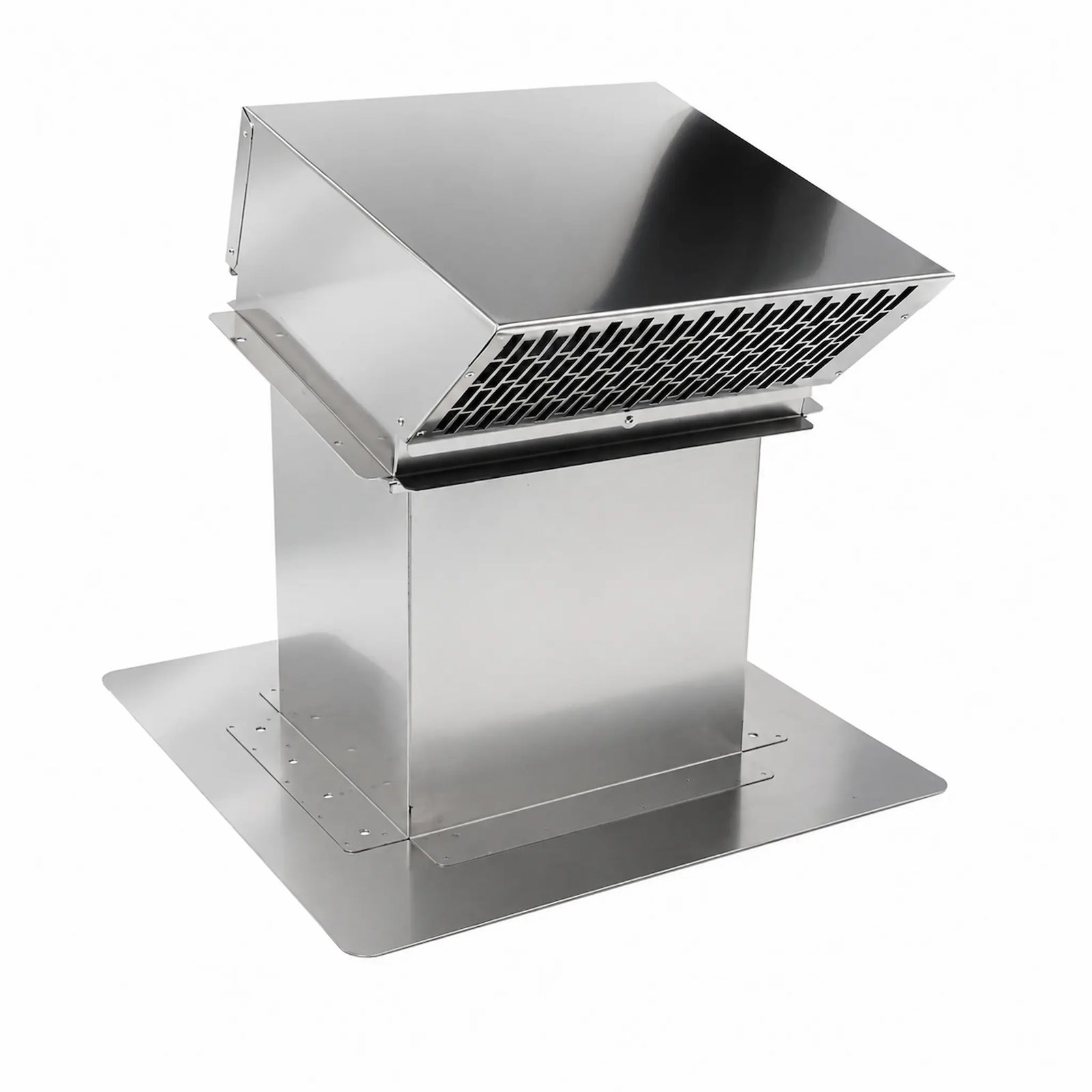
Luxair stainless steel wall-mounted external cooker hood motorView larger ⤢
01 / Outside wall

Wall-mounted motor

An option where a suitable exterior wall offers a practical route from the hood. Confirm the mounting position, duct connection and access for maintenance.

Choose this motor on a product page:Anzi ↗Caporra ↗Tolvi ↗
Luxair external cooker hood motor and housing for a flat roofView larger ⤢
02 / Flat roof

Flat-roof motor

Designed for an appropriate flat-roof installation. Plan the duct route, roof connection, weather sealing and future servicing with your installer.

Choose this motor on a product page:Anzi ↗Caporra ↗Tolvi ↗
Luxair external cooker hood motor for a pitched roofView larger ⤢
03 / Pitched roof

Pitched-roof motor

An option for a suitable sloping roof. Check the roof arrangement, compatible mounting components and access before finalising the installation.

Choose this motor on a product page:Anzi ↗Caporra ↗Tolvi ↗
Choose the complete system, not just the motor rating. Luxair’s collection includes Anzi, Caporra and Tolvi ceiling hoods, with advertised 1400 m³/h and 2000 m³/h external motor options. Check the specification of your chosen combination: installed airflow depends on the complete duct route and its resistance. An external motor is not a universal add-on for every cooker hood.

What to confirm before ordering

  • The exact ceiling hood, motor and control compatibility.
  • The required duct diameter, permitted route, bends and motor position for that system.
  • Electrical connections, mounting, weather sealing and access for servicing.
  • What is included in the package, and which ducting or installation components are supplied separately.

Send Luxair your kitchen plans before ordering, or arrange a home or site survey to discuss the proposed installation.

The duct route is part of the extraction system. Choose the hood and ducting together, especially when a kitchen island or ceiling extractor is involved.

  • Follow the model’s specified duct size. Many Luxair models use 150mm round ducting, with 220 × 90mm rectangular ducting an option where specified. Some systems have different requirements.
  • Keep the route short and direct. Bends and restrictions add resistance. Check the permitted route for your model rather than applying one maximum length to every hood.
  • Prefer smooth rigid ducting where specified. Avoid unnecessary flexible lengths, crushed connections and abrupt reductions.
  • Check the outlet. The external grille, flap and any adapters must be suitable for the airflow and duct system.
  • Keep access in mind. Filters, controls, connections and any remote motor need appropriate access for maintenance.

For a new installation, agree the route with your installer before the kitchen is fitted. If the route is uncertain, a Luxair home or site survey can help identify the practical options.

Send the team a sketch showing duct dimensions, total length, each bend and the proposed outlet. This is more useful than the room size alone.

Include filters, installation accessories, electricity use and maintenance in your comparison. The least expensive hood to buy is not necessarily the best fit for your long-term needs.

Grease filters

Metal grease filters capture grease from cooking air. Clean them using the method and interval in your model’s instructions; cooking frequency and frying can affect how quickly they need attention. Only use a dishwasher if the filter instructions allow it.

Odour filters for recirculation

Charcoal filters reduce cooking odours and require replacement or regeneration according to the specific filter type. Standard disposable filters should not be washed. Check the exact part number, replacement cost and availability before buying.

Energy and lighting

Compare the energy label and annual consumption figures on the same basis. Your actual electricity use depends on fan speed, cooking time and lighting. Check whether task lighting, dimming, remote controls or other features are included on your chosen model.

Keep the model and serial number with your purchase documents so the team can identify compatible filters and replacement lighting later.

Always check the warranty terms for the particular model, including registration requirements and what is covered. Keep your invoice and installation details.

Have these details ready when you compare products or speak to the Luxair team:

  1. Hob: type, width, model and cooking position.
  2. Room: length, width, height and whether it opens into another living space.
  3. Fit: cabinet, wall or ceiling dimensions, mounting height and structural support.
  4. Air route: duct size, length, bends and external outlet, or the proposed recirculation arrangement.
  5. Accessories: compatible filters, ducting, grilles, adapters and any required controls.
  6. Installation: electrical supply, access and the requirements in the hood and hob manuals.
  7. Budget: appliance, fitting, accessories and future filter costs.

For an existing kitchen, include photos of the hob, the available space and any current ducting. For a new kitchen, plans and elevations help the team assess the options before work starts.

Do not order on appearance alone. Confirm the installation requirements of the exact size and motor variant you intend to buy.
Expertise, in your own kitchen

The right advice. The right installation.

Choosing extraction is easier when someone understands your space. Luxair offers home and site surveys, with installation available on request following a survey.

  1. Tell us about your kitchenShare your plans, hob details and the look you want to achieve.
  2. Book a home or site surveyAn engineer assesses the space, extraction options and ducting route.
  3. Discuss your installationInstallation is available on request following the survey, with a quote for your requirements.

Check current survey pricing, availability and booking terms before ordering.

Luxair ceiling extractor installation in an open-plan kitchen
Keep exploring

More detail. More confidence.

Go deeper into installation, hidden extraction and choosing a cooker hood for an open-plan kitchen.

The questions we can help with

Cooker hood buying FAQs

Which type of cooker hood is best?

The best type depends on where your hob sits, the space available and the ventilation route. Start with a wall-mounted or canopy hood for a wall position, a ceiling or island hood over an island, or a compatible extractor hob or downdraft when you want the area overhead to stay clear.

Do cooker hoods have to vent outside?

No. Some models can recirculate using a compatible odour-filter kit. Ducted extraction sends captured moisture outside; recirculation returns the air to the room and does not remove that moisture from the home. Check the model’s supported modes and plan suitable room ventilation.

What cooker hood works in a small kitchen?

A built-in or canopy hood can preserve a coordinated cabinet layout, while a wall-mounted design may suit a clear space above the hob. Check internal dimensions, ducting and maintenance access. Choose by the hob and installation as well as the room size.

Can I use a cooker hood above an induction hob?

Yes, when the hood is suitable for the installation and fitted to the appliance instructions. Pay particular attention to capture width, positioning and condensation. The sizing section above gives Luxair’s starting recommendations for overhead induction extraction.

What is the difference between a canopy and an integrated hood?

A canopy hood normally fits into the underside of a cabinet or decorative housing. An integrated design is concealed within the cabinetry, often using a matching front or opening panel. Terminology can overlap, so compare the actual fitting drawings and opening mechanism.

How high should a cooker hood be above the hob?

There is no single height suitable for every hood. Follow the exact hood and hob installation instructions, including minimum clearances and any maximum effective height. Ask Luxair or your installer to resolve any conflicting requirements before installation.

Does Luxair offer site surveys and installation?

Yes. Luxair offers home and site surveys to assess suitable extraction and ducting options. Installation is available on request after a survey, with pricing based on the engineer’s assessment. Visit the survey and installation page for the current booking process and terms.

What should I send Luxair for help choosing?

Send your hob model and width, room dimensions, available fitting space and photos or kitchen plans. Include whether you can duct outside and any proposed duct dimensions, length and bends. Contact the team for help narrowing your shortlist.

Complete your extraction setup

Filters, ducting & aftercare

Find the finishing pieces for your installation, then keep your cooker hood working at its best. Check compatibility with your model before ordering.

Here to help after purchase

Support for the life of your hood

Register your warranty or arrange help from the Luxair repair team.

View all Luxair collections →

Let's find the right cooker hood.

Send your hob size, kitchen dimensions and photos. We can help you narrow the choice.

Get expert advice ↗

Filmed using real smoke, no CGI
Click to pop-out video